
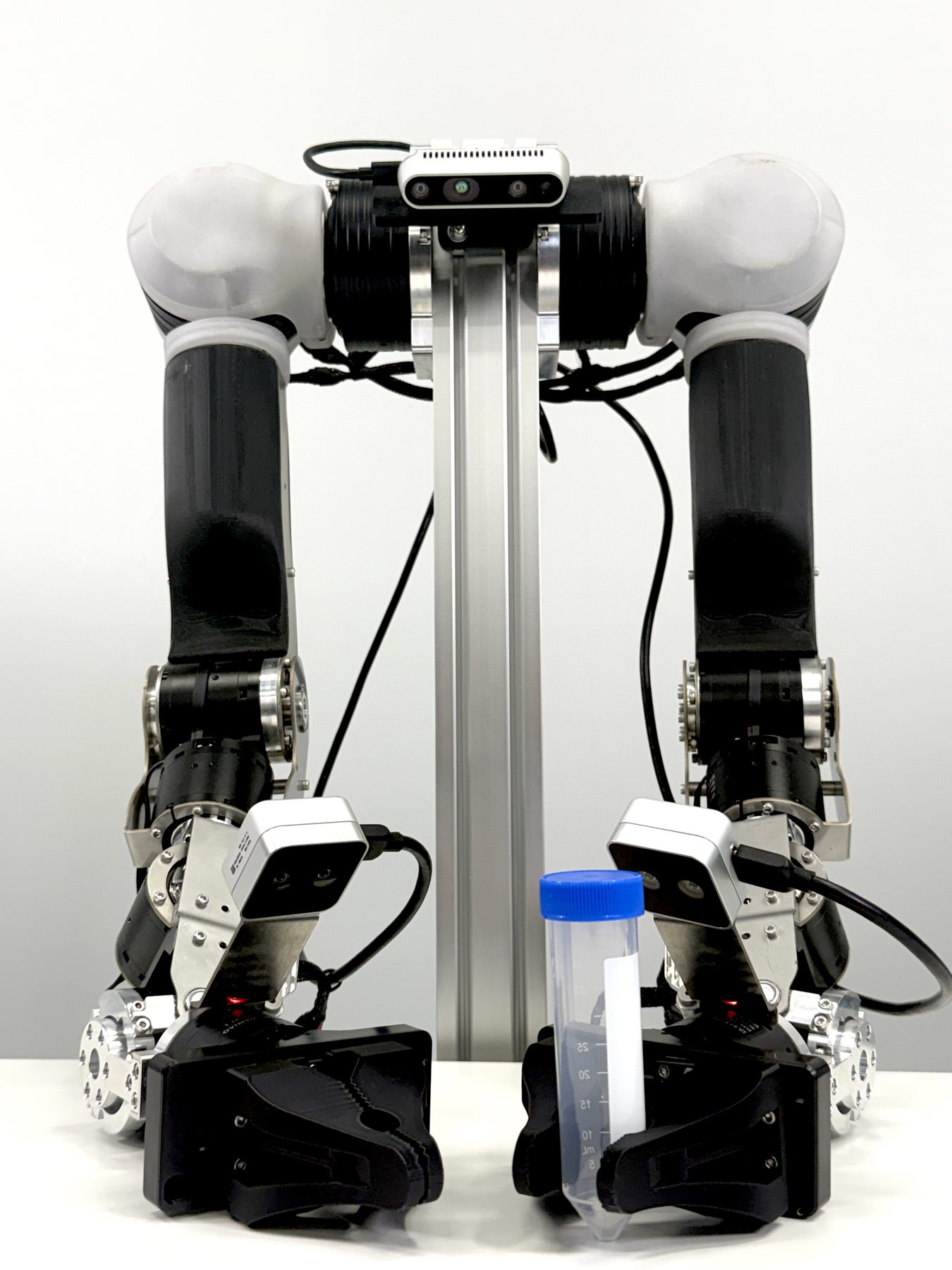
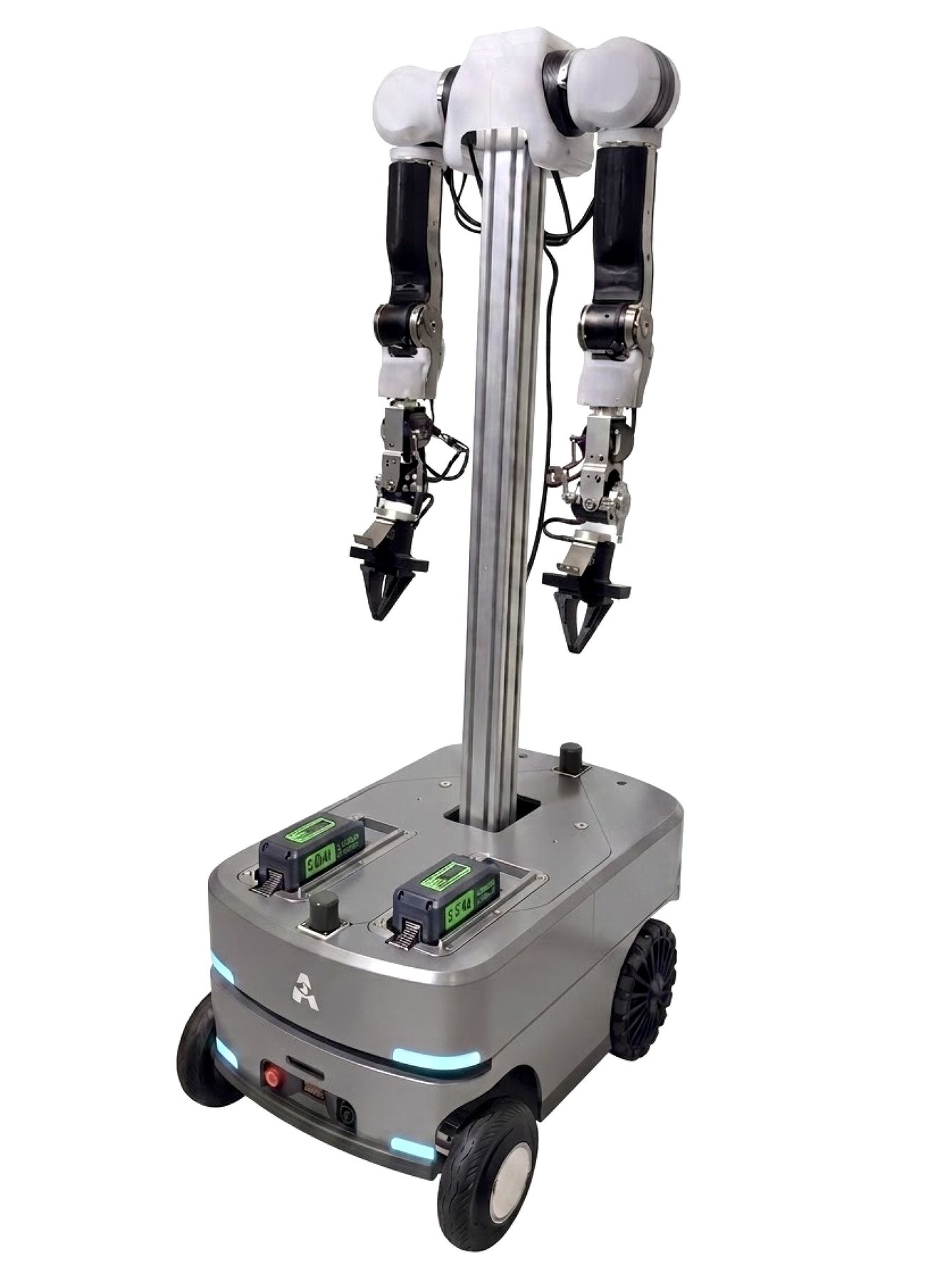
Configuration overview
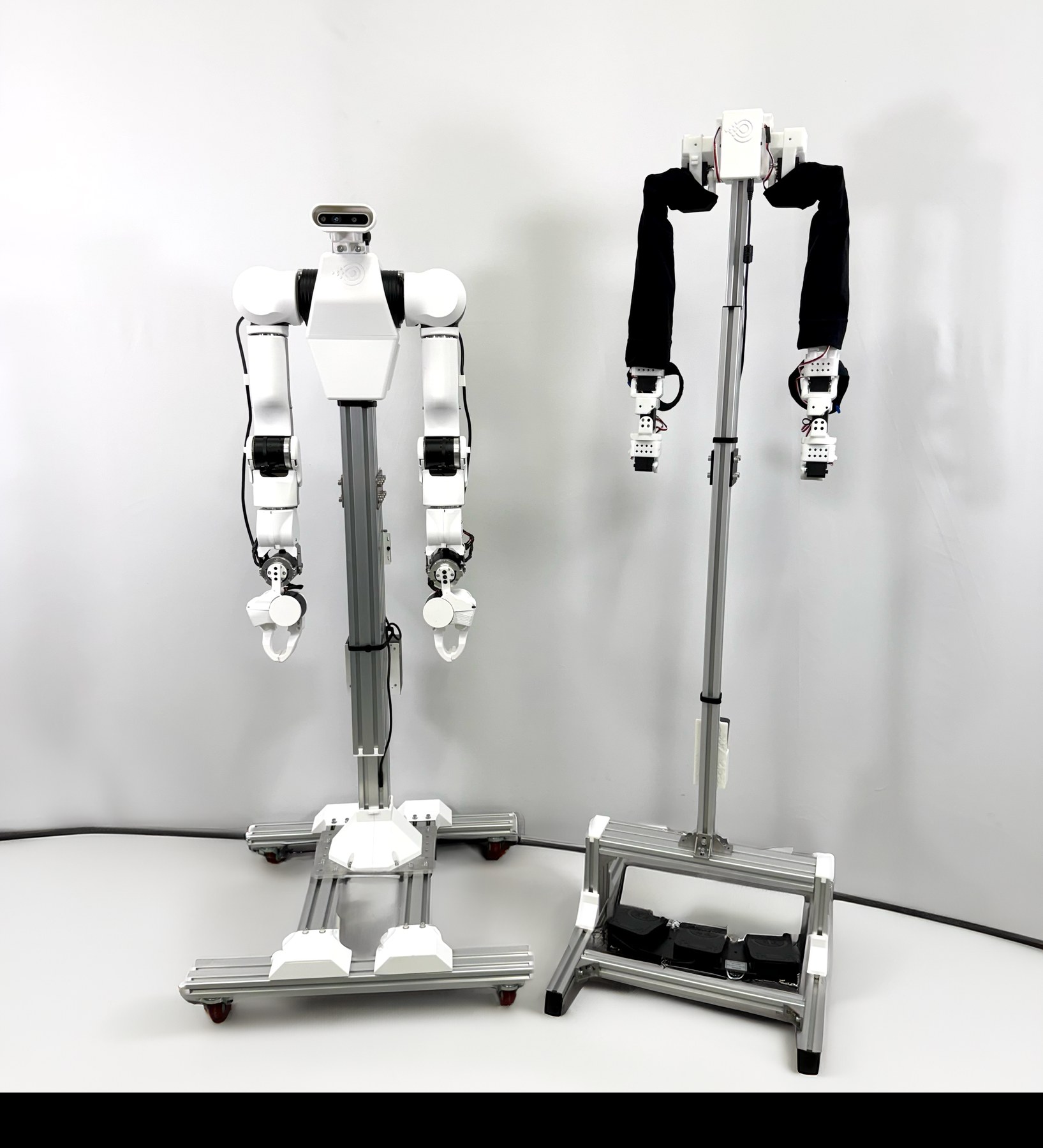
Yuri Desktop mounts the bimanual arm assembly on a height-adjustable desktop stand — stationary in use, with casters so it can be rolled to a new spot — for benchtop research; Yuri Mobile places the same assembly on the MobileBase platform for room-scale work. Everything above the base is shared.
| Parameter | Yuri Desktop | Yuri Mobile |
|---|---|---|
| Platform / mount | Integrated desktop stand — height-adjustable, casters for repositioning | MobileBase (two-wheel differential-drive AMR) |
| Total degrees of freedom | 14 (2 × 7-DOF arms) | 14 (arms) + 2 (differential-drive base) |
| Mobility | Stationary in use — casters allow manual repositioning | Two-wheel differential-drive AMR (non-holonomic) |
| Power source | External 24 V DC supply (mains powered) | Dual 24 V Li-ion hot-swap packs · 288 Wh |
| Follower arms | 2 × 7-DOF OpenArm 2 (Sensori-enhanced) | 2 × 7-DOF OpenArm 2 (Sensori-enhanced) |
| Leader arms | OpenLeader force-feedback pair | OpenLeader force-feedback pair |
| Reach per arm (with gripper) | 630 mm | 630 mm |
| Bimanual wingspan (gripper to gripper) | 1,615 mm | 1,615 mm |
| Arm standing height (base plate to shoulder) | 1,023 mm | 1,023 mm |
| Deployment modes | Leader-follower teleop · Quest 3S teleop · policy rollout | Leader-follower teleop · Quest 3S teleop · policy rollout |
| Origin platforms | OpenArm 2 (Sensori-enhanced) | OpenArm 2 (Sensori-enhanced) + Sensori MobileBase |
Arm specificationsIdentical on both
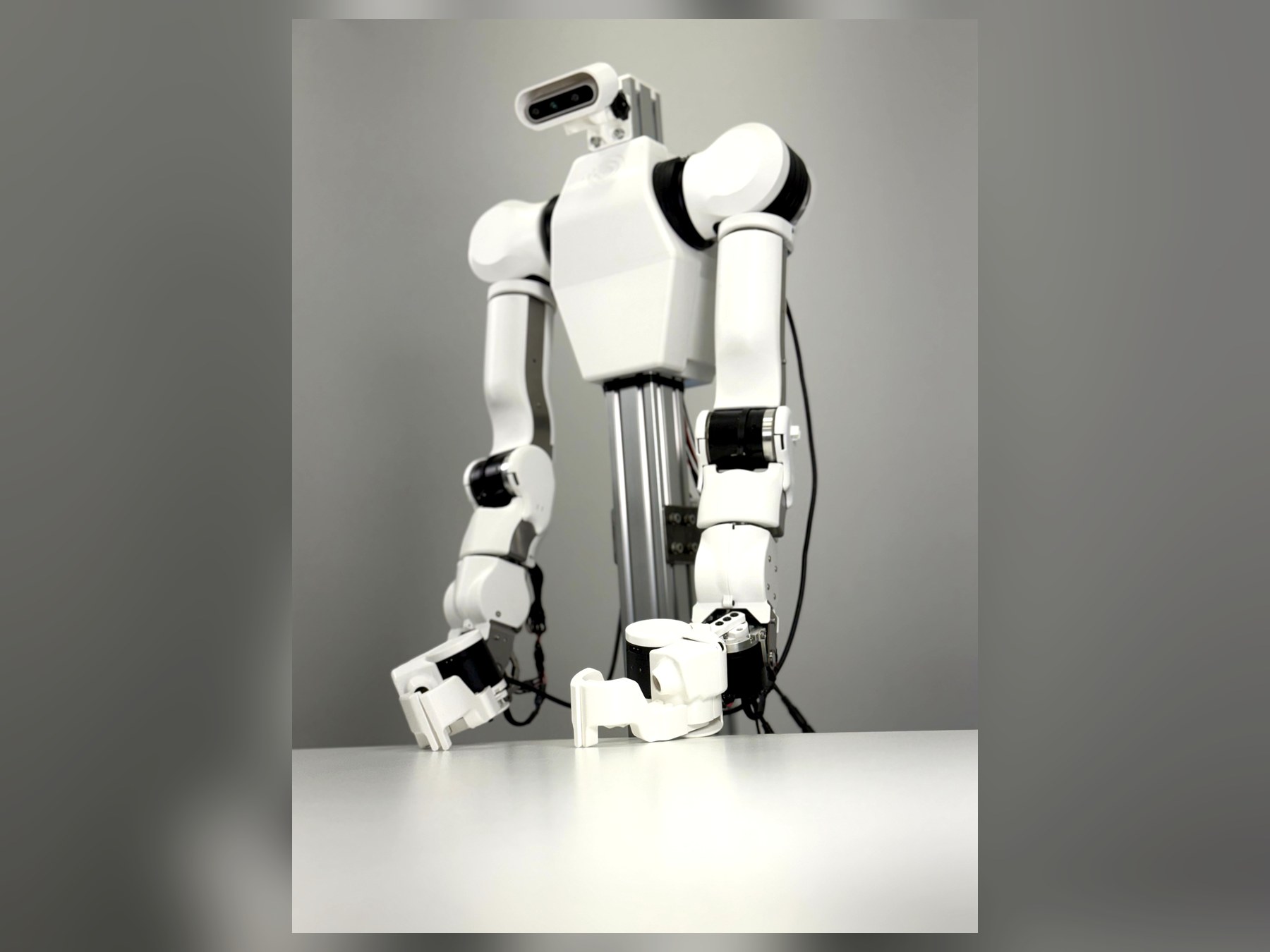
Each of Yuri's arms has seven degrees of freedom — matching the reach and dexterity of a human arm — and is built from CNC-machined aluminum and sheet metal. Every joint is highly backdrivable and reports torque in real time, making Yuri well suited to delicate, contact-rich manipulation and to bilateral teleoperation. Values reflect the as-built geometry, including the 250 mm extended pedestal and 25 mm extended upper arm.
| Parameter | Value (Desktop & Mobile) |
|---|---|
| Degrees of freedom | 7 (revolute) |
| Reach per arm (with gripper) | 630 mm |
| Standing height (base plate to top of shoulder) | 1,023 mm nominal (773 mm OpenArm + 250 mm extended pedestal) · stand height adjustable |
| Bimanual wingspan (gripper to gripper) | 1,615 mm (630 + 630 + 305 + 25 + 25) |
| Nominal payload (held 1 min, arms fully extended) | 4.1 kg |
| Peak payload (3 s motion + 1 s hold, worst posture) | 6.0 kg |
| Total bimanual mass (arms + base plate + pillar) | 14–15 kg |
| Construction | CNC machined parts and sheet metal |
| Backdrivability / compliance | High — suited to contact-rich tasks and bilateral teleop |
| Safety | Mechanical end-stops on every joint |
| Actuator family | DAMIAO DM-J4310-2EC · DM-J4340-2EC · DM-J8009P-2EC |
| Joint encoders | 14-bit single-turn magnetic encoders (×2 per joint) |
| Control interface | CAN-FD (MIT protocol) · high-speed teleop & control loop |
Actuator specificationsIdentical on both
Yuri's arms use three DAMIAO motor variants, chosen by joint location: the J8009P and J4340 drive the shoulder and elbow, while the more compact J4310 powers the forearm and wrist.
| Parameter | DM-J4310-2EC | DM-J4340-2EC | DM-J8009P-2EC |
|---|---|---|---|
| Rated torque | 3 Nm | 9 Nm | 20 Nm |
| Peak torque | 7 Nm | 27 Nm | 40 Nm |
| Rated speed | 120 rpm | 36 rpm | 100 rpm @ 24 V / 200 rpm @ 48 V |
| Max no-load speed | 200 rpm | 52 rpm | 160 rpm @ 24 V / 320 rpm @ 48 V |
| Reduction ratio | 10 : 1 | 40 : 1 | 9 : 1 |
| Rated voltage | 24 V | 24 V | 24 V (24–48 V supported) |
| Rated / peak current | 2.5 A / 7.5 A | 2.5 A / 8 A | 20 A / 50 A |
| Outer diameter | 56 mm | 57 mm | 98 mm |
| Height | 46 mm | 53.3 mm | 61.7 mm |
| Motor weight | 300 g | 362 g | 896 g |
| Encoder | 14-bit magnetic (×2) | 14-bit magnetic (×2) | 14-bit magnetic (×2) |
| Control interface | CAN-FD | CAN-FD | CAN-FD |
The DM-J4340 series is not strictly a QDD motor — it was selected to balance payload capacity with a compact form factor.
GripperIdentical on both
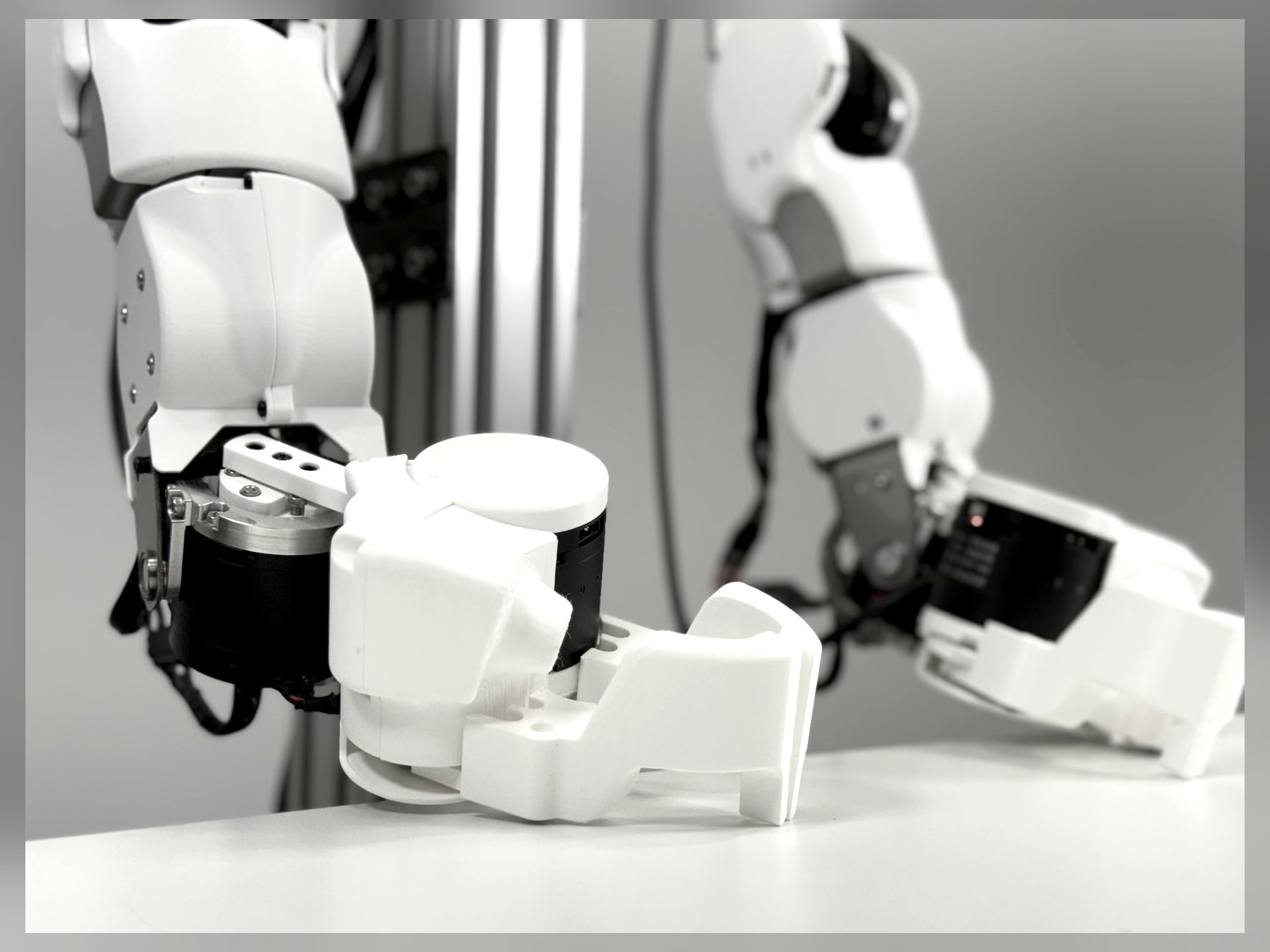
Each Yuri arm terminates in a parallel-jaw gripper purpose-built for force feedback and bilateral control — smooth, low-friction motion that lets operators feel what the robot is doing.
| Parameter | Value (Desktop & Mobile) |
|---|---|
| Maximum jaw opening | 88 mm (jaw-to-jaw) |
| Rotor travel | 60° from fully closed to fully open |
| Zero position | Fully closed (jaws in contact) |
| Motion hardware | Ball-bearing slider blocks and linear rails · bearings at all linkages |
| Suitability | Exceptionally smooth motion — tuned for force feedback and bilateral control |
| Actuation | DAMIAO motor over CAN-FD (shared arm bus) |
Leader armsIdentical on both
Every Yuri — Desktop or Mobile — ships with a matched pair of OpenLeader force-feedback leader arms mounted on their own stand. Teleoperate the follower arms and feel exactly what the robot feels.
| Parameter | Value (Desktop & Mobile) |
|---|---|
| Configuration | Matched pair of leader arms on an integrated stand |
| Force feedback | Bilateral — operator feels contact forces at the follower |
| Teleop modes | Bilateral and unilateral leader-follower |
| Control interface | CAN-FD (MIT protocol) |
MobileBaseYuri Mobile only
Yuri Mobile's base is a two-wheel differential-drive AMR (autonomous mobile robot) with support casters, sized to carry both arms, research-grade compute, and a full sensor pack — maneuvering across flat indoor environments. Yuri Desktop omits the base entirely; its arms sit on a height-adjustable desktop stand with casters — repositioned by hand, not driven.
| Parameter | Yuri Desktop | Yuri Mobile |
|---|---|---|
| Drivetrain | None — unpowered casters for manual repositioning | Two-wheel differential drive (AMR) with support casters |
| Top speed (preliminary) | Stationary | ~1.0 m/s unloaded · ~0.5 m/s full payload |
| Deck payload (preliminary) | N/A | ~40 kg (arms, compute, sensors) |
| Max slope (preliminary) | N/A | ~5° (flat-floor environments) |
| Battery | External 24 V DC supply (mains powered) | Dual 24 V Li-ion · 6 Ah per pack · 288 Wh · hot-swappable (one pack at a time) |
| Charge time | N/A | ~2 hours to 80% (standard charger) |
| Navigation sensors | N/A | RGB-D front camera (optional pack) |
| Safety features | Emergency stop button (halts arms) · blinking indicator light in operation | Emergency stop (halts arms and base) · audible siren on keep-out-zone entry · blinking indicator light in operation |
| E-stop | Hardware e-stop button | Hardware e-stop button + wireless remote e-stop |
Electrical & communications
Yuri's electrical architecture is built for deterministic, low-latency control and clean integration with research compute. A dual CAN-FD bus handles high-rate arm and gripper traffic, while host networking and protected power rails make it easy to add sensors, radios, or accelerators. Only the power source differs between configurations.
| Interface | Yuri Desktop | Yuri Mobile |
|---|---|---|
| Arm ↔ host | Dual CAN-FD bus | Dual CAN-FD bus |
| Gripper ↔ host | CAN-FD (shared bus with arm) | CAN-FD (shared bus with arm) |
| Host ↔ external network | 10GE-RJ45 · Wi-Fi 802.11ac | 10GE-RJ45 · Wi-Fi 802.11ac |
| Teleop link (Quest 3S) | Wi-Fi, < 10 ms round-trip on local network | Wi-Fi, < 10 ms round-trip on local network |
| Power bus | External 24 V DC supply (mains) · 5 V & 3.3 V accessory rails · reverse / over / under-voltage & inrush protection | 24 V DC from onboard batteries · 5 V & 3.3 V accessory rails · reverse / over / under-voltage & inrush protection |
| Aux I/O | 1× USB 2.0 · 1× USB 3.0 · M.2 Key B (internal) · MiniPCIe (internal) | 1× USB 2.0 · 1× USB 3.0 · M.2 Key B (internal) · MiniPCIe (internal) |
Sensors
Yuri carries an RGB camera at each wrist for close-range manipulation and demonstration capture, plus a forward-facing depth camera for safety, mapping, and scene understanding. The front camera differs by configuration: Yuri Mobile uses the IMU-equipped D435i for navigation.
| Sensor | Yuri Desktop | Yuri Mobile |
|---|---|---|
| Wrist cameras | RGB camera (one per arm) | RGB camera (one per arm) |
| Front / head camera | Intel RealSense D435 depth camera (safety & scene) | Intel RealSense D435i depth camera with integrated IMU (navigation & safety) |
ComputeIdentical on both
Every Yuri ships with a preconfigured NVIDIA Jetson AGX Orin — ready out of the box for on-robot AI training, low-latency inference, and teleoperation on day one. On Desktop the compute is housed in the stand enclosure; on Mobile it is mounted inside the MobileBase.
Standard
NVIDIA Jetson AGX Orin · 64 GB unified memory · 275 TOPS · 12-core Arm Cortex CPU · Ubuntu 22.04 + ROS 2 Humble.
Use cases
On-robot fine-tuning of VLA policies (GR00T, Pi-0.x, X-VLA, SmolVLA), low-latency inference, and Quest 3S / leader-arm teleop — all on the same compute node.
Storage
Dedicated data SSD for dataset capture; swappable via front-panel bay.
Compute module — bill of materials
The compute module is built from the following components (mounted in the desktop stand enclosure on Desktop, or inside the mobile base on Mobile):
| Component | Part / model | Manufacturer |
|---|---|---|
| AI compute module | Jetson AGX Orin, 64 GB | NVIDIA |
| Carrier board | reServer Industrial J501 | Seeed Studio |
| Storage | M.2 M-Key NVMe SSD | Apacer |
| Wi-Fi / Bluetooth | AW-CB375NF · M.2 E-Key module | AzureWave |
| Ethernet ↔ CAN 2.0 converter | UIM2523 | UIROBOT |
| GNSS / RTK (optional) | F9P · Mini PCIe | ArduSimple |
| GNSS antenna (optional) | Multi-band helical antenna | SparkFun |
| Mobile 4G / 5G (optional) | M.2 B-Key cellular module + antenna | TBD |
Software stackIdentical on both
Yuri ships with a pre-integrated, pre-tested software image — fully open source and designed to be customized, extended, and rebuilt to fit your research stack.
| Layer | What ships (Desktop & Mobile) |
|---|---|
| OS | Ubuntu 22.04 LTS (PREEMPT_RT kernel optional) |
| Middleware | ROS 2 Humble with Sensori-maintained meta-packages |
| Motion | MoveIt 2 · Sensori CAN-FD arm driver · gravity compensation |
| Teleop | Unilateral & bilateral leader-follower · Quest 3S IK app · joystick/web fallback |
| Data | LeRobot dataset format · Foxglove bridge · MCAP recording |
| Simulation | URDF/MJCF for MuJoCo · USD assets for Isaac Lab · Genesis integration |
| Management | Sensori support image with signed OTA updates |
Operating environmentIdentical on both
| Ambient temperature | 10 – 35 °C (operating); 0 – 45 °C (storage) |
| Humidity | 10 – 80% RH, non-condensing |
| Environment | Indoor, flat floors — research labs, offices, homes |
| Noise level | < 55 dBA at 1 m during typical teleop |
Sourcing, compliance & warrantyIdentical on both
| Arms | OpenArm 2 with Sensori Robotics enhancements |
| Hardware licensing | Apache-2.0 (software) · CERN-OHL-S-2.0 (OpenArm hardware) |
| Documentation | Sensori integration guide + links to the canonical OpenArm docs (docs.openarm.dev) |
| Warranty | 1-year limited warranty from date of shipment on the integrated Yuri system (arms, base, compute, accessories) |
| Support | Direct engineering support via email and a private Slack / Discord channel for the warranty period |